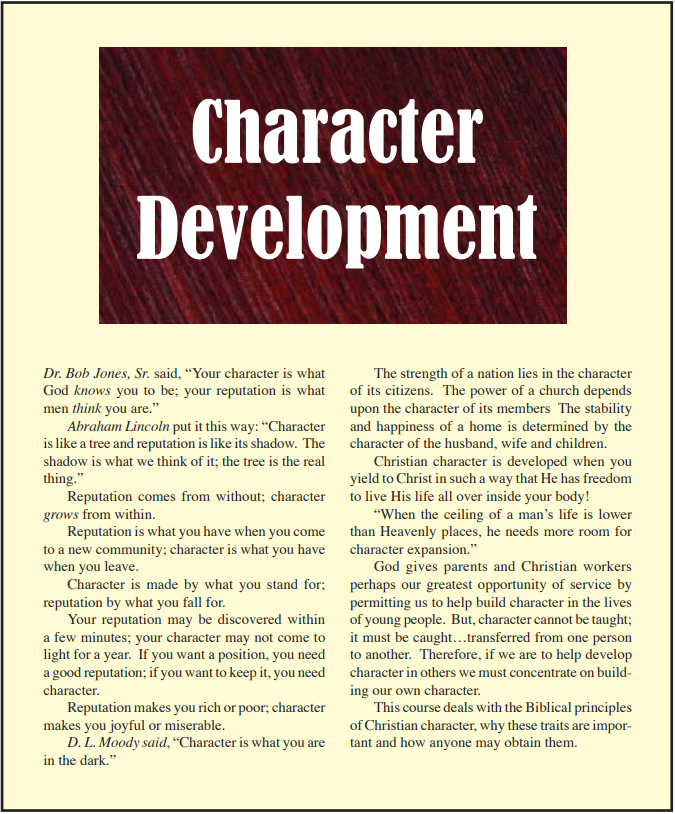
What are seven differences between Reputation and Character (see previous page)?
| Character | Reputation |
|---|---|
| what God you to be | what men you are |
| grows from | comes from |
| is made by what you for | is made by what you for |
| may not come to light for a | may be discovered in a few |
| is needed to keep a | is needed to get a |
| makes you or | makes you or |
| what you have when you a community | what you have when you into a new place |
- D. L. Moody said, “Character is what you are in the ."
- What three basic institutions are dependent upon the character of their people for success?
A.B.C. - Note the Christian’s position (Ephesians 2:6). Christ has “ us up
,and made us together in places in Christ Jesus.” - List the 9 Christian virtues mentioned in Galatians 5:22-23.
- A.
- B.

- C.
- D.
- E.
- F.

- G.
- H.

- I.
- List the things we are to think about as Christians (Philippians 4:8)
Things that are: - A.
- B.
- C.
- D.

- E.
- F.of
- G.
- H.
When a person devotes his entire life striving to get money or power or honor, he always winds up being a loser. Even if he is able to reach his goals in life, he finally agrees with Solomon that all was vanity. At best, (or actu- ally at worst), he would be like the great conqueror who had won empires. Although he ruled multitudes and had great wealth, the monarch somberly requested that he be buried with his hands uncovered, to remind the world that he could carry none of his spoil with him into eternity. Yet there are certain things, fruits of character, that men do carry with them out of this world. A man’s character does not die with the man. It stays around his home after he is buried. It lives in the community where he was known. And, at the same time, he carries his character with him into the other life. Character, good or bad, lives forever! “Bury my influence with me,” begged a dying young man, his life wrecked by sin and carelessness. But that is not possible. Your influence is as immortal as our soul. Even today, the entire world is affected by the disobedi- ence of Adam and Eve. Cain’s murderous character fills our minds with bitterness. And Abel, who “offered unto God a more excellent sacrifice…being dead yet speaketh” (Hebrews 11:4). Our character not only endures to influence others, but it is built by the influence of others upon our lives. In ancient times, the word “character” referred to the stamp or mark used by an engraver, brick maker, or other crafts- man to distinguish what he had made. Applied to life, character shows what our experiences have impressed upon our souls. A baby has no character. His life is like a blank sheet of paper, ready for something to be written. Every day
as the baby grows some mark is made. His mother writes something, as does his daddy and his grandparents and his teachers and his friends and all of his acquaintances. Every day’s experiences write some new words. Every influence of other lives leaves some mark. Temptations and struggles do their part in filling the page. Books, TV and radio programs, everything he sees and hears either paints some line of beauty or scratches an ugly mark. Final character is shown when the page is filled, the picture finished. Christian Character is a matter of maturity. Proper development takes both time and effort. Christ’s char- acter is the model for every Christian life. We will not become just like Christ in the twinkling of an eye. John Stott reminds us: “You can become a Christian in a mo- ment, but not a mature Christian. Christ can enter, cleanse and forgive you in a matter of seconds; but it may take a lifetime for your character to be transformed and molded to His will.” While viewing a great painting, a young artist said to Ruskin: “Ah, if I could only put such a dream on canvas.” “Dream on canvas?” growled the critic. “It will take ten thousand touches of the brush on the canvas to make your dream come true!” But it is easier to put the dreams of an artist on canvas than to put the character of Christ into a life. The cost of fulfilling God’s purpose for our lives is always high. We must painfully prune away everything that does not please God if we are to flourish with the fruit of Christlikeness. Self-denial is required. Our natural desires must be put to death if Christ within is to control and be revealed to others.
- What does a person both take with him and leave behind for others when he dies?
- What did the word “character” refer to in ancient times? .
- Everything a person sees or hears either paints some line of
or scratches an
mark upon his character. - Proper character development takes both and effort.
- is required for character development.
- What does God intend for us to become, according to:
Ephesians 1:4
.
Romans 8:29 .
I John 3:2
- God created our “new man” after Him in and true holiness.
- Although plans and dreams can be very important, only gets the job done.
- The Gospel books do not record the thoughts of Jesus; they tell us only about His
- Over and over the Lord Jesus demonstrated that He is an
- The Gospel of Luke is “about all that Jesus began to and teach.”
- Luke’s second book is not called “The of the Apostles” but “The Acts of the Apostles.”
- Christ’s matched His words.
- According to James 2:17, is meaningless without action.
- “Let us not love in word, neither in tongue, but in and truth” (I John 3:18).
- The secret to stability in any life is
- If we obey God’s command, we will have God’s
- When God made us, He gave us the faculty of knowledge, the ability to feel and sense, and a will—the ability to make
- Even without any motivating emotions, we must still learn to
- Love is always a Love is something a person not something he simply feels.
- In Matthew 5:44, the Lord Jesus commands us to do four things to our enemies:
A. them,
B. them,
C.do to them,
D. for them.
These four things can be done without any - God provides the for whatever He commands.
- Our actions will control our
- We are not commanded to thankful; but we are commanded to give thanks.
- Action gives ; doing precedes knowing.
- A person must himself into a new way of feeling; he must not try to feel himself into a new way of acting.
- To act the way God wants us to be, in order to obey Him regardless of our feelings, is not hypocrisy—but
- Match the Spiritual Thought with the Correct Passage:
“I must be about my Father’s business.” A. I Samuel 21:8
Work, while you still have the opportunity B. James 1:22
Diligence gets the attention of royalty C. Romans 12:11
Do your task with all your might D. Proverbs 22:29
Be doers of the Word, not just hearers E. Ecclesiastes 9:10
The King’s business requires haste F. 1 Corinthians 14:12
Stir yourself by remembering God’s blessings G. 2 Timothy 1:6
Don’t lag in diligence; be fervent in spirit H. Luke 2:49
Your labor in Christ is not in vain. I. John 9:4
Work to edify the church. J. 1 Corinthians 15:58
Character is “doing what is right because it is right.” In biblical terms we are talking about righteous men and women, men and women who do what is right for the right reason.
So, to be persons of character, we must submit ourselves to God’s code of conduct. We must agree with Him that His ways are right when we understand, don’t understand, and misunderstand. We must in effect say, “Lord, before
You even tell me what the right thing to do is in my particular situation, I want You to know that I believe You are right.”
And second, we must follow through. We must do what is right. Why? Because we will always come out looking good? No. Because it’s what we want to do? No. Because it will keep us out of trouble? No. People of character
do what is right because it is right.
— Charles Stanley
- Wrong actions can adversely affect one’s
and bring into his life. But a person’s actions
may be correct and proper while he is utterly defeated by wrong
reactions to:
A. life’s
B. other , - List six common, but wrong, reactions:
A.
B.
C.
D.
E.
F.
- Our actions may sometimes hide our true character from someone because actions may be planned and for his benefit. But our reveal what we really are.
- In a non-Christian world we are going to be in ways.
- Give two Scripture references showing that Christians should not be surprised when they are hated and misunderstood.
A.
B. - Since the Bible teaches that Christians can expect to be
mistreated and misunderstood, we should ask the Lord to help us
to be prepared and ahead of
time, so that our reactions will be right,
mature and - Why did Christ react properly to the temptations of Satan in the
wilderness? There was and a
of . - We should not be shocked when religious people, even
Christians, are sometimes unkind, , critical,
,quarrelsome and . - Our reactions
what we

really are - If we react in the same manner that other
persons act toward us, those persons Us. - If someone acts toward us in an evil manner, God says we are
not to be guilty of in an
- Regardless of what other people do to us, we have the strength in
Christ to: and in
spiritual . - The Christian must be controlled by
alone. - Nothing can hurt us except our
Romans 8:28 teaches us that it makes no difference what
happens if we really believe that
God allows in our is working for our
, and that whatever happens makes a
to our lives. - Even our “enemies” are really friends, if we are
and have the right
to them. - The situation God allows does not hurt us; it will help us if our reactions to it are
and
and proper. - Name six people who could not be stopped by their unpleasant
situations:
A. Helen
B.
C. Thomas
D.
E. Abraham
F. the Apostle - What will happen if we react with…
A. resentment? It will us.
B. bitterness? It will us.
C. self-pity? It will us.
D. anger & hatred? They may result in Or
bodily - It must be admitted that others are guilty of wrong actions, but the
Bible says that are for our wrong reaction. - If God is to work on our behalf, we must have a desire
to see what is wrong and be willing to acknowledge our
for it. - What three steps must Christians take to properly take
responsibility for our wrong reactions?
A. We must that we have seen what our reactions
have about us.
B. We must refuse to and ourselves
C. We must fully our - The secret of having perfect reactions in any situation is to let
the Lord who lives within in us the same way He
when He was here on the earth - In Genesis 37, verse
, we are told that Jacob
his
year-old son, Joseph, more than all his children.
Jacob’s reaction to Joseph was one of conspicuous recognition
showing - Jacob himself had been reared in a home where
was shown. - In addition to the home and family, partiality is often common (and
deadly) in and in the - The Bible says it is not wise to
ourselves with
others. Neither should we children with other children. - A child must have love.
- Of the 21 GI’s who defected to Communism during the Korean
War, of them came from homes where they felt unloved
and Only one of the twenty-one was ever
chosen by his for anything. - Sin first came into the
, where Satan
does his deadliest work.
- Jacob’s wrong reaction was showing
partiality. - Jacob’s sons reacted with
to his reaction
to Joseph. Whenever someone is favored in a family, the rest of
the family react usually with to the
one favored. Joseph’s brothers reacted against him with cruel
- Joseph reacted to the rejection of his brothers with creative
- What is the result when we react in the same way others have,
with hatred and hostility? We are no than they
are and we are as as they are. - Another ruinous way people sometimes react to their
problems is by becoming
and , and giving in to feelings of
and self- . - Joseph was not controlled by his
- God often prepares us for responsibility by permitting
and sometimes even
- We use “creative resignation” when we decide to take the adverse
situation as from , and believe will
us in it. - Joseph’s right relationship to God and to his difficulty enabled God to:
A. him in his
B. the entire house of - Husbands and wives will find that their entire home can be
blessed if they have the:
A. right to
B. right in their
C. right to their - A person who is serving the Lord faithfully and honoring Him in
his reactions will not be without future , as
Joseph’s story shows. - What four important lessons does Joseph’s ordeal with Potiphar’s
wife teach us about temptation?
A. Temptation comes to people; to any
in any
B. Temptation comes spiritual
and often a great
C. Temptation often come from
D. Temptation is - What are some lessons we learn can from Joseph’s reaction to
this temptation?
A. His reaction was clear and on the side of
B.He teaches us to God for
testings and to fear only
C. Consider every
a stepping stone to
D. Know that is against
E. Determine to be at any - Joseph’s reaction to his erring brothers after he had become prime
minister of Egypt was one of retaliation, which
means and . - Joseph turned his problems into
.
his persecutors into his because he had the
right - The right reaction to “enemies” is to them
We talk about our evil world, but actually this is an ideal
world for God’s purposes--building character.
— J.B. Chapman
If adversity develops character, prosperity demands it.
— J.D. Eppings



- The Greek language has
words for love, but only
are used in the Bible. The word that is not used carries
the meaning of a passionate, type of emotion.
The second word has to do with filial, or love.
The third word represents a love that has only for its
source. This love manifests itself in spite of:
A.
B.
C. anything that might try to it - In Ephesians 3 Paul prayed that the Ephesian believers would be
and in this special love. - The is the prerequisite to love.
- Man is a triune being, with a
and
- Love must be appropriated by
- The whole love of God is found in
.To be rooted
and grounded in love means that we are so To
Christ that we are with Him. This can be illustrated by a
planted in the ground. - God wants us to be able to comprehend with all saints what is
the , , and
of His love. - The greatest thing in the world is
- The great love chapter in the Bible is 1 Corinthians
- Without love the gifts of the Spirit will lead only to
,
conceit and , and these in turn lead
to of others and to telling about them. - The word translated
is the strongest Greek word
for love. - In Galatians 5:22 this love is presented as part of the
of the of the , - From I Corinthians 13 we learn that even though we may…
A. with special
B. have the of
C. understand all
D. have all
E. have enough to move ...
yet we will be ineffective if our gifts are not practiced in love. - In the book of Revelation, we find that the problem with the church
of Ephesus was that they had their first love. This first
love involves a genuine to Christ; it is a self-
love. - Love is cultivated in our
life.
Christian activity which robs us of our
with Christ also robs us of our
. - The of constrained Paul to work for Him.
- Two phases of love that God would have us practice are:
A. love to
B. love for other - Many, like the Ephesian church, try to substitute
for love. - Our love toward others is the measure or
of our
love toward Christ. - Labor becomes burdensome toil when
is
; but when we love Jesus Christ, our work for
Him is a of . - Take time in the
so that your love for Him will
. - There may be zeal for the truth in denouncing sin, but if that zeal
is not motivated by for , it can easily
become for the sinner. - What are the 3 R’s from the message to the Ephesian church that
all Christians need to remember?
A.
B.
C. - There is a warning of
for those who do not
return to their first love. Christ says He will come and remove
that person’s (or ministry’s) , which
speaks of the witness of the Holy Spirit’s . - If our love for
is lacking, that indicates that our
love for is lacking. - The love of God shed abroad in our hearts is not necessarily
expressed by an feeling. - How many statements are given about love in 1 Corinthians
13:4-8? These can be classified under different
headings. - List the 16 characteristics of love in I Corinthians 13:4-8 (KJV):
A. suffereth
B. not
C. all things
D. all things
E. not itself
F. is not
G. doth not
H. seeketh not her itself
I. is not easily
J. no
K. rejoiceth not in
L. all things
M. all things
N. never
O. rejoiceth in the
P. is - The first four characteristics can be classified under the heading
of .What two Old Testament characters
are given as examples of having God’s patience of love?
and . - Love endures
. When other people wrong us,
returning evil for good, we will suffer that without
if we have the of God in our hearts. - Love knows no limit to its
; it bears up
under . It can overlook
in others. -
will never be heard from

a person whose heart is filled with God’s .
- True love endures without divulging its
to the world. - Love hopes under all
.
Love is optimistic instead of all the time. - Love has the power to endure
Love holds its - The world makes much of love, but it knows
of the love of I Corinthians 13. Only a
person has that. - The second quality of love is
. Love
looks for ways to be rather
than . Such love leaves no room
for any . it is . It
demonstrates grace and confers instead
of hate. It is good; it seeks the of others. - Another quality of love is
.Love
is not . True love knows no
. Everything you and I have belongs
to is ours. True love is
; it envies not. - At least
statements are made in verse 4 concerning
the component of love called .True love
its accomplishments, even from .
Love never . It never . Love
does not sound its own . Inwardly, love is not
. It is not arrogant or
. It is - The fifth component of love is
. If a
person’s heart is full of the love of God, he will act with
and kindness.
Inconsiderateness, lack of and
will not be seen, for love has good
. - The fact that love “seeketh not her own” shows us that another
element or result of love is
Love is not self-
Love does not insist on getting its own - In Romans 15:1-3, we are told “not to please
. Let everyone of us please his
…even pleased not
Himself…” - Happiness lies not in having or
but in
- From I Corinthians 13:5 we learn that love controls a person’s
- Love is
. Rather than thinking
, it searches for the - Love rejoices in the
.This has reference to both the
of the Word of God and to
expressed in the of God’s people. Real love hates
but loves the - The love of I Corinthians 13 has no origin in
. It is
completely of Though it is a gift, it is more than that:
it is a , God’s in us. But it
is even more than that. It is actually a . It is
in us. - The first and essential element of attaining this heavenly love is
for us to have a heavenly . We must be
from above. - There is much imitation, or synthetic, love. But the love of Christ is the true, the pure, the
product, free from
and .This heaven
produced and heaven love is produced in us by the
, . - What three things are we to consent to, with our actions and our minds, if God is to do mighty things in producing His love in us?
A. We must everything to Him.
B. We must regularly “ in the
C. We must be rooted and in His love. - To be filled with the fullness of God is a matter of
to Him and daily Him to fill our hearts with His
“If ye love Me, keep My commandments” (John 14:15)
True Character Does Not Come Quickly or Naturally
We may speed up our travel and our reading these days, but not experience. It must be seasoned and there is no way to grow a saint overnight. Speed reading was never meant for Bible study. And character—like the oak—does
not spring up like a mushroom.
Today the quality of our church people is at a frightening low. We are many but not much. Doing has become a substitute for being and we have failed on character. We are conformed to the age but not to the image
of God’s Son.
And we do not naturally get better. Right here is a problem that stumps the evolutionist. If we are evolving upward all the while, why did the perfect Man appear two thousand years ago? Why can’t we produce a greater
character than Jesus Christ? We’ve had more than twenty centuries since He appeared and we haven’t had a person who can say, “Which of you convinceth me of sin?”
What is the answer? “Christ in me, the hope of glory.”
— Vance Havner (adapted)



- When we look unto Jesus in the Scriptures, we find:
IN His Our: - What is our Lord Jesus doing for us right now, according to
Hebrews 9:24?
- His grace enables us to be:
A. with His
B. with His
C. with His and
His strength is made perfect in our - The expectation and hope of His certain return, at an uncertain
time, encourages God’s faithful people in
watchfulness and that the Savior is at hand. - By Christ our faith can be
, encouraged,
and led on to its supreme consummation. - If we look at ourselves instead of Christ,
our attention is selfishly given to:
A. our
B. our
C. our
D. our
E. our
F. our
- Looking at the world instead of Christ gives our attention to:
A. its
B. its
C. its
D. its
- To look steadily unto Jesus and follow Him would save us from:
A. useless
B. disturbing
C. of
D. dangerous with
E. of
F. empty
G. bitter
H. sorrowful
I. - If we focus our attention to our obstacles, these obstacles will
amaze us, us and us. - With Christ’s help, our troubles can produce sanctification,
, sympathy and .Apart
from Him, troubles harden or crush us and produce rebellion,
and - By looking to His cross, we can accept our cross, and carry it with
love, with , with - We must look unto Jesus and not to our
which is good only to glorify ourselves. Neither should we look at
our , for doing so will not make us
become stronger. - The law gives
, but gives no strength to
carry them out. The law always , and never
. The law is our schoolmaster, teaching us to
look unto Jesus, not to itself. - It is possible to be occupied so much with what we are doing that we
forget Who we are doing it for! It is possible to have the
full but the heart empty. If our heart is filled with His , how
can our hands fail to be in His service? - God requires us to give an account of our
, not of our
success. To look at the is to walk by sight; to
look at Jesus and keep serving Him, in spite of all
is to walk by - If we focus our attentions on the bright joy, strong assurance
or warm love we sometimes feel—then all will seem lost when
these seem to be missing. When we have lost these feelings,
we will think we have lost our , and
will allow ourselves to fall into the abyss of
even unto cowardly , or perhaps sinful
. - Look at the Victor, not the victory. If we look at our defeats we
shall be . ; if we look at our victories we shall
be . Look at neither. - Go back through the chapter to
complete the following list of things
that we are not to look at:
Looking unto Jesus, and not at…
A. (our thoughts, etc.)
B.the (its customs, etc.)
C.
D.our (no matter how evangelical)
E.our
F.our (in the church or elsewhere)
G.our (not even the most beloved)
H.His or our
I.the (in our path)
J.our (tasting their bitterness)
K.the dearest of our
L.the God employs
M.the that we have
N.the of our
and the strength of our
O.our , which only glorifies ourselves
P.our , which does not strengthen us
Q.our (not their source or what they deserve)
R.our of
S.the (which condemns but never pardons)
T.what we are for Him
U.the apparent of our
V. the spiritual or at the amount of
that are sins cause
W.the of our ,
the of our or
the of our .
X.the of that we have attained
Y.our or our
Z.our or our
- It is from Jesus and in Him that we learn to know what it is
for us to know about the and about
ourselves, our ,our ,our
and our victories. - Look to Jesus until the promised hour, the blessed hour when at
last “we shall be Him; for we shall Him as
He .”
We must never put character in the place of faith. Our character can never be meritorious before God; we stand before God on the basis of his grace. Character is the evidence that we are built on the right foundation.
—Oswald Chambers (1874–1917)
The expression of Christian character is not good doing, but God- likeness. If the Spirit of God has transformed you within, you will exhibit divine characteristics in your life, not good human characteristics. God’s life in us expresses itself as God’s life, not as human life trying to be godly. The secret of a Christian is that the supernatural is made natural in him by the grace of God, and the experience of this works out in the practical details of life, not in times of communion with God.
—Oswald Chambers (1874–1917)
Looking unto Jesus
just three words, but in those three words is the whole secret of life, and the key to Christian character development.