God in
American History
Copyright © 1983, 2012 PBI Publications
All Rights Reserved,
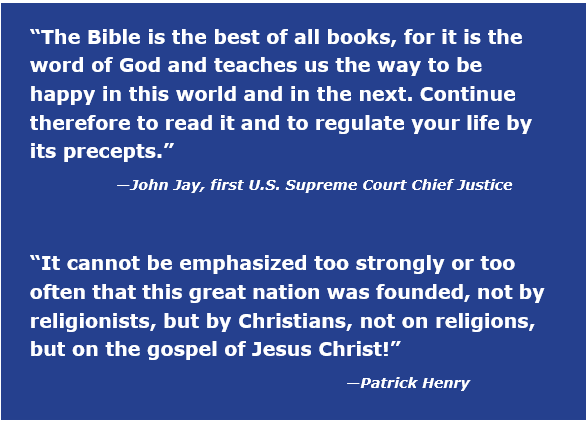
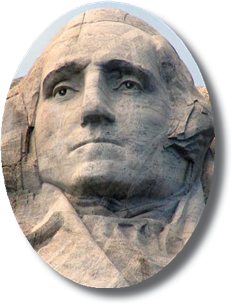
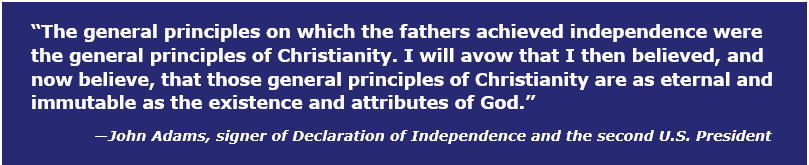
George Washington said:
“It is impossible to rightly govern the
world without God and the Bible.”
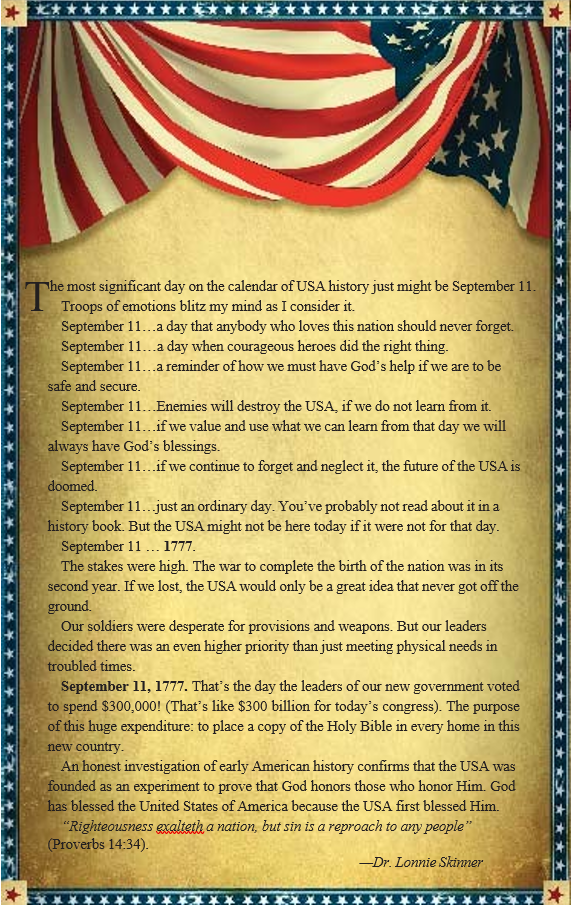
Think about this statement of the first President of the United States! What incredible insight and foresight! This conviction brought God’s great favor to America!
Note the strength of Washington’s statement. He did not say it would be nice or even wise for us to include the Lord in our government. He said it is impossible to rightly govern the world if the leaders do not follow God and His Bible!
Unfortunately, most of today’s national leaders do not seem to understand or agree with such a premise. (How is that working out?) America’s only hope is found in God and His Word!
Answer the following as you review the Introduction on the preceding page:
Chapter 1
Introduction
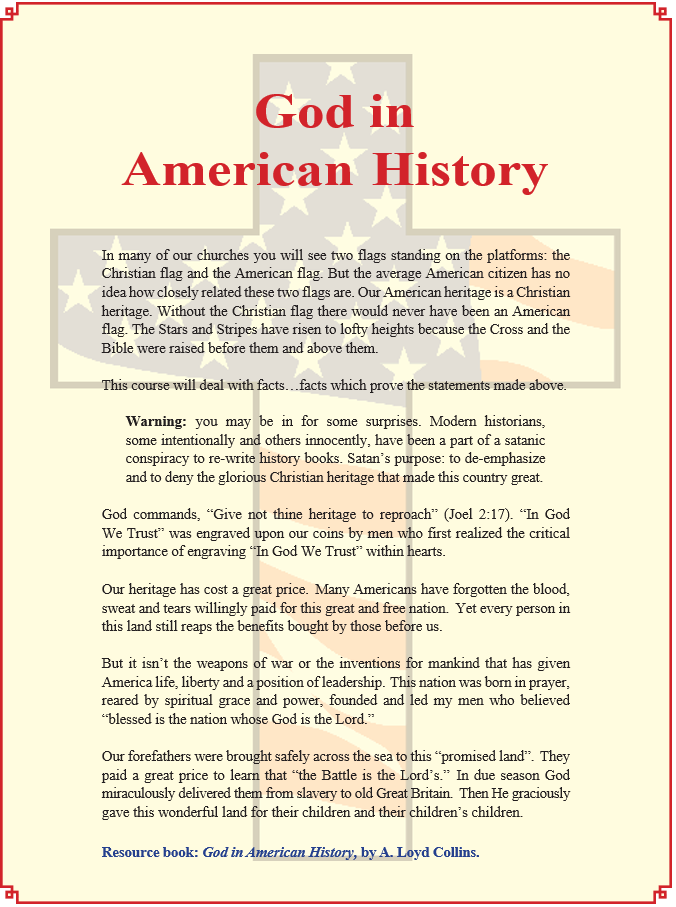
- Without the flag there would never have been an flag.
- What is Satan’s interest and purpose in wanting new American history books?
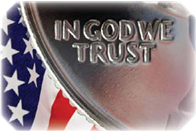
- “In We ” (our national motto) needs to be engraved within , not just on our coins.
- America was...
A. born in
B. reared by spiritual and
C. led by men who believed “ is the whose is the .” - Name two of the early American writers of history who made frequent mention of the role God played in our nation’s history?
A.
B. - must never become a substitute for God and His work.
- The secret of our nationaly success will be found in our and in God.
- We have founded our way of life upon the Christian principles of...
A.
B. - God has on America as He has never on any other nation.
Answer the following as you read your resource book:
Chapter 2
God and Our Colonial Forefathers
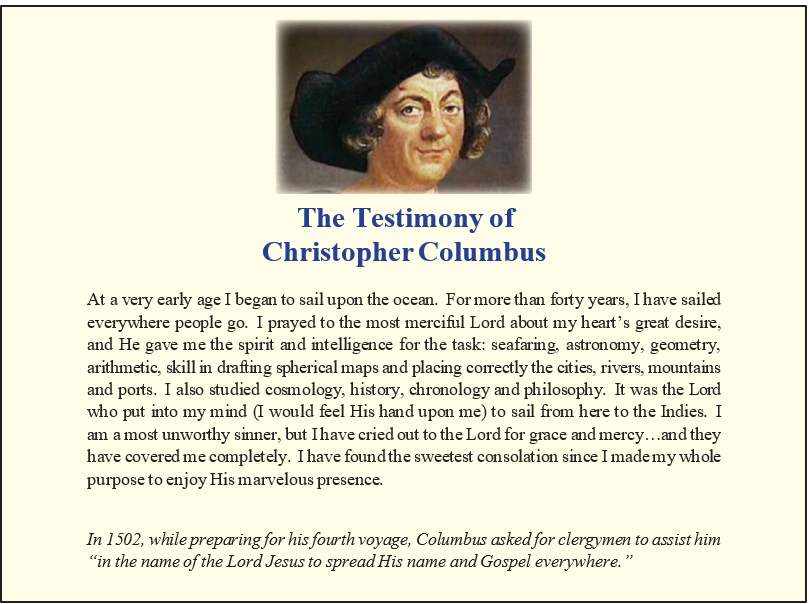
- When Columbus discovered this land he reportedly...
A. “Lifted up his heart and eyes to , and poured forth ejaculations of and to ”
B. Led the crew in a of to the Lord.
C. When they reached America’s shore, they fell down on their in the by the seashore to thank for His and . - What was the desire of Columbus concerning the Indians?
- Columbus cried out to the Lord for and .
- Nearly 500 years earlier Eric the Red’s king admonished him “to proclaim ” in new lands and to teach truth.
- Why were priests or chaplains taken with the early Spanish explorers?
A.
B. - The French brought with them to the New World.
- What did DeSoto reportedly tell the native Americans who thought he was from Heaven?
- What did the first charter of Virginia (1606) state as a primary purpose of English colonization in the New World?
- A minister had come with John to the new world in 1497.
- How soon was a church building erected by the settlers at Jamestown?
- In many early charters and grants of land in America, a purpose was expressly pointed out.
- Whose warning prevented the complete annihilation of Jamestown (1622)?
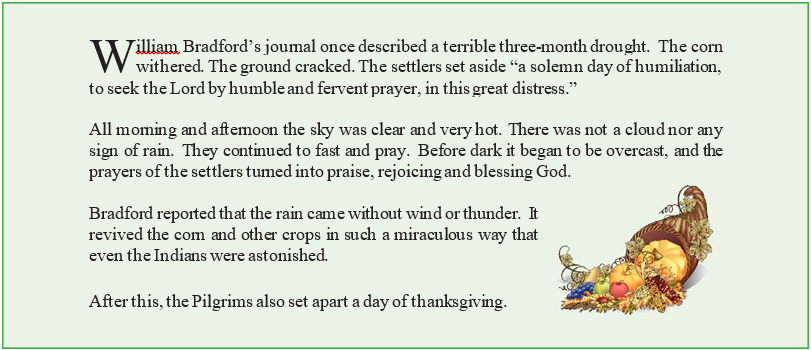
- Before they started for Virginia the Pilgrims resolved to “seek of a way for us, and for our ones.”
- In the “Mayflower Compact” the Pilgrims stated that they had undertaken their little settlement “for the of , and the of the .”
- Their governor (and chief historian) was William .
- What did the Pilgrims do as soon as they landed?
- The thanksgiving day was first held by the Pilgrims in the fall of .
- The Plymouth monument says: “They brought up their families in sturdy virtue and a living in God, without which nations .”
- Governor Bradford’s gravestone gives this challenge: “What our father’s with so much attained do not basely .”
- The Puritans planted their colony in the year .
- What did the Puritans do each day during their voyage to Salem?
A.
B.
C. Their ministers expounded “a in the ” - Their first governor was John . He once wrote his wife: “We here enjoy and .”
- Massachusetts considered itself “a state, dependent upon none but .”
- John was probably the first Protestant minister to preach to the Indians in their native tongue.
- What were the main points of the “dangerous theology” of Roger Williams?
A. He spoke against church and
B. He opposed the union of the and the
C. He contended that the land which England claimed was the just of the and that the had no to give it away
D. He opposed civil
E. He preached that it was not lawful for to join in with the . - Williams started a settlement he called .
- Roger Williams founded the first Church in the U.S.
- Rev. John led his flock in establishing Connecticut.
- Lord Baltimore established Maryland as a refuge for Roman who had been persecuted in .
- A Religious Act passed in gave freedom of worship to any “person professing to believe in .”
- To be able to vote in South Carolina, the constitution required a person to “Acknowledge the of , and to believe in a future state of and .”
- One of the requirements to be able to vote in Delaware was “a of in God, the Father, , his only , and the Ghost, God, blessed for evermore.”
- William Penn was the leader of the , who led in the establishment of the colony of .
- What four provisions for his colonial policy made it ideal?
A. Provided for government.
B. Cheap
C. toleration
D. A just and fair of the - Penn established Philadelphia, the city of “ .”
- Only were to take part in government.
- Georgia prohibited and the traffic.
- A 1647 Massachusetts law said children should be taught to read because tried “to keep men from the of the ,” and that “ should not be in the of our fathers.”
- The pioneer Readers, among others, uplifted Truth.
- History books began the history of mankind with and .

Our founding fathers obviously believed in freedom of religion, but not freedom from religion.
Chapter 3
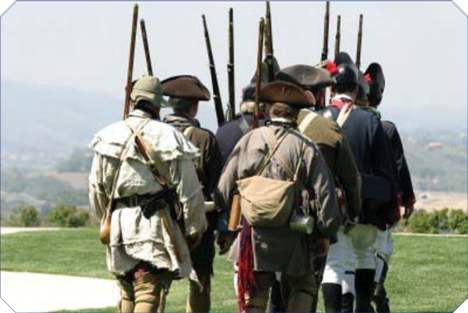
How God Helped Us Win Our Independence
- When did the American Revolution take place? -
- In spite of our inadequate equipment and , we had faith in and in the justice of our .
- How were our colonists divided in their attitude toward the war?
A. One-third were of the ;
B. One-third were to ;
C. One-third were - One newspaper said: “Liberty is the of , and cannot be .”
- What motto was written in gold letters around some of the drums? “ who over their fathers will the sons.”
- Dr. Jacob , chaplain of the First Continental Congress which met in the year of , asked the Lord to “look down in , we beseech Thee, upon theseAmerican States who have to Thee from the of the , and thrown themselves upon Thy gracious , desiring henceforth to be only upon .” He further prayed… “Be Thou , O Lord of , and direct the of this honorable …Preserve the of our bodies, the of our minds.”
- The Declaration of Independence concludes with these words: “For the support of this declaration” we look “with a firm on the of Divine .”
- Rev. Jonas fought with the Minute Men, who were led by Paul .
- At Concord, the prayers and sermons of William had so aroused “the of his , that they held the of their a part of their with .”
- On the evening of the first major battle, at Hill, the soldiers paused, took off their and their for as they leaned on their . Chaplain led in a fervent prayer asking the Lordfor , leadership and , which could come to them from in their hour of great and tribulation.
- An old grey-haired farmer prayed aloud as he aimed his musket: “I thank thee, O Lord, for me to this day for my country. Blessed be the name of the Lord.”
- Before the Battle of Long Island, Trumball wrote: “Notwithstanding our are numerous, yet knowing our cause , and trusting will us, I do not greatly what they can do us.”
- To enable Washington to transport the army of men by boats from Long Island, God suddenly calmed the high northeast wind that had raged for days, sent a gentle breeze from the and which aidedthe movement of the boats, kept the nearby enemy ships from seeing them in bright moonlight, and sent a thick sea around the camp as daylight came.
- What did the Pennsylvania German Lutherans write concerning Washington’s December 26 victory over the Hessians at Trenton? “Until that hour, the of the United States like a dying . But the of hosts the of the distressed, and sent an for their .
- Washington gave the credit for the victory.
- About midnight on January 1st, God again used a miraculous change in the to help keep the battle for liberty alive.
- Although he had many narrow escapes from death, George Washington went through the entire long war of years without or as much as a to his person.
- What were seven of the tasks carried out by the faithful chaplains?
A. the
B. in
C. the
D. the men concerning spiritual and personal
E. Administered to the in the
F. Helped to and for the
G. Said services over the - The colonies of and furnished almost fifty percent of these army chaplains.
- Match the following chaplains with their records:
John Gano A. killed while escaping Sunbury prison Moses Allen B. lived 62 years after retirement William Plumb C. Pastor, 1st Baptist Church, New York Charles Thompson D. killed in Trenton-Princeton campaign John Roseburg E. taken prisoner in June of 1778 - Some records indicate that John baptized George Washington.
- Watt’s from a Church helped win a battle when used as gun for muskets.
- The of Rev. James Caldwell was brutally murdered by the enemy because of his zealous endeavors in the of the colonies. Rev. Caldwell himself was shot in November of .
- Valley Forge may be called the of our struggle for .
- Rev. M. L. wrote of Washington’s prayer in the snow.
- What were among the final words of British Major Patrick Ferguson at King’s Mountain in South Carolina?
- The devastating damage of Benedict Arnold’s treason was foiled when British Major was captured with the incriminating papers for the capture of .
- Benedict Arnold has become the of American History.
- After Cornwallis finally surrendered at Yorktown, the Continental Congress met early in the morning and marched in a procession to the Church in Philadelphia to render in a special to God.
- Prayer and meetings were held everywhere all over the country to God for the which brought about the of the .
- A at sea had prevented the escape of at Yorktown.
- Though England could perhaps have still won the war had they continued fighting and sent reinforcements, decreed otherwise.
- John McArthur claims that the United States was actually born out of a of New Testament principles, and any God has bestowed on America have come in of that by the Founding Fathers.
- Albert Soto asserts that the Colonists used Scripture to their in the most of ways.
- Such charges do not accurately reflect the extended debates that at the of the American Revolution.
- Reformation leaders turned to the and found much guidance on the subject of civil disobedience and to civil authority.
- John Adams specifically recommended the works of Poynet to readers who wanted to the theological in the American founding.
- In Scripture, God Himself raised up leaders such as Gideon, , Jepthah, and to throw off governments— leaders subsequently in Hebrews 11:32 for those of .
- Founding Father James Otis explained that the only king who had a “ right” was Himself; beyond that, had ordained that should rest with the .
- Samuel Adams specifically recommended a study of the in order to the of America’s against a king.
- The Founders clearly believed that they were not in to God’s ordained of civil government; they were only resisting and not the itself.
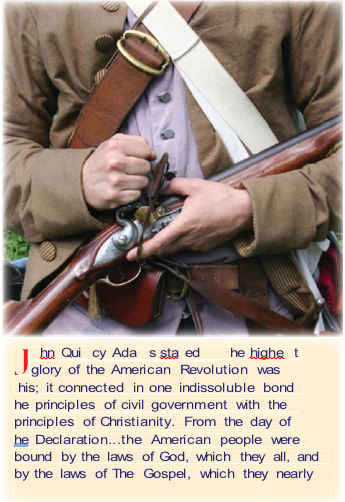
- John Quincy Adams said the Colonists were associated bodies of civilized men and in a state of nature but not of . They were bound by the of (which they all) and by the of the (which they nearly all) acknowledged as the of their .
- What was the first national motto proposed for America in August 1776? “Rebellion to tyrants is to .”
- Having been fired upon without having broken any law, the Americans they had a right to -.
- Hopkinson said one purpose of defensive war is to secure the of humanity and the blessings of to yet . He later added that defensive is not only but an indispensable .
- James Wilson affirmed man does not exist for the sake of but is instituted for the sake of man.
- For years (from 1765 to 1776), the Americans had diligently pursued and not .
- During the last two years of America’s appeals her peaceful were directly met by military . King George III dispatched British troops to his Colonies, enter the of his citizens to their private and , and them without .
- The Colonists acted on the basis of what two theological understandings?
A. God Himself had ordained the of civil .
B. God had explicitly civil -. - Today’s critics are either about the actual and writings from the Reformation through the Revolution, or they with the positions held by the FoundingFathers, , and of that era. It does not mean that there was no basis for the American Revolution.
- Even in the British Parliament it was acknowledged: If you ask an American, “Who is his Master?” He will tell you he has —nor any but .
“The great, vital, and conservative element in our system is the belief of our people in the pure doctrines and the divine truths of the Gospel of Jesus Christ. In this age, there can be no substitute for Christianity...That was the religion of the founders of the republic and they expected it to remain the religion of their descendants.”—United States Congress, 1854
Chapter 4
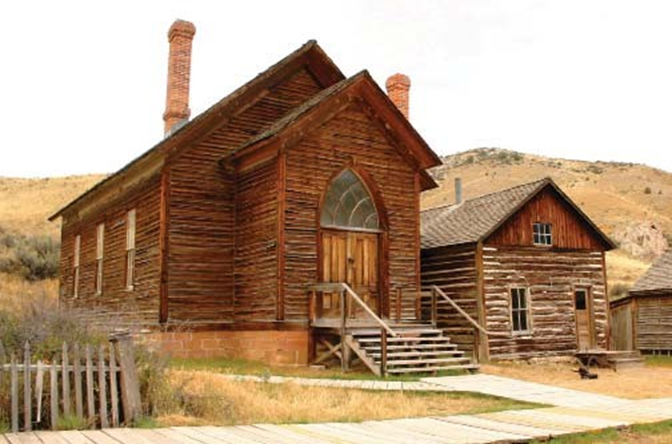
God, Young America and the Early West
- After the Revolution, George Washington believed the future of the United States would be determined by how we to the .
- Washington once told Congress: “…Heaven can never smile on a that disregards the rules of order and .”
- Traveling preachers during the early westward movement were generally called “ .”
- Champ Clark described the early Western American pioneers as:“ people who crossed the Great with a in one hand and a in the other…the of their age and the makers of the .”
- What did John Mason Peck want to see accomplished for the Lord?
A. the of
B. the of in the
C. the of men for the - What were common subjects for sermons in those days?
A.
A.
A.
A.
A. punishment - In these services, the sat on one side of the church building and the on the other.
- The meeting was the most important gathering in the pioneer community. It would last for a or more in late or early . Time was spent in , praying and God.
- The first permanent non-Catholic church organized west of the Mississippi was established in July of ; the first log church building was erected there in .
- Church rules stated that male members missing meetings shall be cited to give their .
- In 1838, permission was granted to hold in the church building.
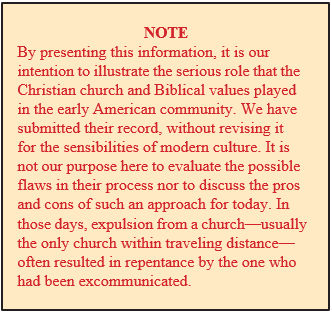
- The church ruled that - of the church should have power to members from the church for conduct. Members who refused to vote on either side of a question were required to give their .
- List the chief reasons for the expulsion of members from the Bethel Church:
A.
B.
C.
D. Unlawful
E. Telling
F. Failing to just
G. in transactions - During the early years, Bethel Baptist Church started other churches.
- The church ordained or licensed preachers.
- A total of members were received between 1806 and 1813.
- In his message to Congress asking for a declaration of war in 1812, President James stated that he was committing “a just into the hands of the Almighty of .”
- God got the attention of Thomas Hart when a gun exploded at the place where he had been standing moments earlier.
- Daniel Webster said, “The most important thought ever to occupy my mind is that of my individual to .”
- It was Commodore Perry’s custom to have a concert of music on his flagship every afternoon.
Chapter 5
God and the American Civil War
- The Civil War took place from the year until .
- Some believe this tragic war was part of God’s chastisement upon America because of the sin and of human .
- Among Abraham Lincoln’s character traits historians note . . .
A. his love for
B. his devotion to his
C. his charitable treatment of
D. his humanitarian-mindedness which looked to but tempered “ with .” - Mr. Lincoln said: “I do not know where the ship of will finally take me, but there is one thing that I do know . . . I know the of that and I have been assured all along the by the gentle of His upon .”
- The special day for national prayer and humiliation was requested by the of the United States, men who Mr. Lincoln said devoutly recognized “the supreme and government of in of the affairs of and of …”
- He said it is the of nations and individuals to:
A. own their upon the overruling of
B. confess their and in humble , yet with hope that genuine will lead to mercy and
C. recognize the sublime , announced in the Holy and by all - He said the only nations that are blessed are those “whose is the .”
- He further stated…
A …we know that …nations and individuals are subjected to punishment and in this world
B. “We have been the recipients of the choicest of … but we have God.”
C. “Intoxicated with unbroken , we have become too to feel the of and grace, too to to the that made us” - Because of these facts Mr. Lincoln said: “It behooves us, then, to…”
A. ourselves before the offended
B. our national
C. for and - The results desired from this “united cry” to God was that they would “be heard on high and answered with of no less than the of our national , and the restoration of our now and country to its former condition of and .”
- General Robert E. Lee was the son of the famous Lee, a hero in the War.
- Mr. Lee once said, “My chief concern is to try to be a , sincere .”
- He said he had “never seen the when” he did not for the people of the as well as for those in the .
- How did Southern soldiers often know they were about to engage in battle?In the dim light of the campfires at they could see General “Stonewall” Jackson upon his in .
- Quotes from General Jackson’s letters to his wife include the following:
A. “God has been my .”
B. “God has been our , and to Him be all the .”
C. We should “all more in imploring aid in our .” - General “Jeb” Stuart said, “I ascribe to the the and the .”
- Lossing, the historian, describes thousands of Union chaplains as “faithful of the Divine Master, and full of toward their , their and their God.”
- Most of the soldiers carried little in their packs.
- In one of the many revivals in Southern camps it is reported that men in a Mississippi brigade made of .
- In a four-month period more than of Lee’s men were saved.
- Many men entered the as a result of these army revivals.
- Jefferson Davis’ last official message to the people of the Confederacy was:“Let us not but on the never-failing and protecting of .”
- According to the historian Motley when the war ended the order of the day seemed to be “humble, grateful to ” that the Union had been saved.
Answer the following concerning Mr. Lincoln’s first Thanksgiving Day Proclamation:

Chapter 6
God in America
Yesterday, Today and Tomorrow
- A few years after the Civil War a great spirit swept the country, beginning in the .
- Before the Civil War much of the country was involved in a spirit of reforms and a higher of human .
- Typical aftermaths of the war included:
A. increase in
B. the accumulation of huge
C. a wartime in the North
D. , frauds,
E. lowering of standards
F. and living
G. trade
H. graft and - Many outlaws, such as the and boys claimed to be victims of circumstance.
- D.L. Moody, probably the “father” of American of the nineteenth century , had been led to Christ by Edward .
- Dr. Reuben Archer (R.A.) Torrey was the Dean of the Bible Institute in and pastor of the Church there.
- J. Wilbur , a third great evangelist, was led to Christ by . Not only was this man a great evangelist himself, but he started “Billy” in his great work.
- Billy Sunday’s New York City campaign in 1917 lasted and a half months. came forward for salvation in this one meeting.
- William Jennings said parents wanted their children to bewell versed in the , but that they did not want them to manifest so much interest in the age, or the age of that they would lose sight of the “ of .”
- In President McKinley’s last speech to the American people the day before he was shot he said: “…our earnest is that will graciously vouchsafe , happiness and to all our neighbors, and like to all…people…”
- Theodore Roosevelt was a , frank, , and straightforward man.
- Woodrow Wilson was the son of a minister. He called the Bible “The of the human .” He said, “We do not expect our children to be Christian, if we do not take the to be ourselves.”
- Mr. Wilson’s final message to the American people pointed out that our only hope for the future was ; that we could not survive unless we were “permeated” with the and of .”
- General John J. Pershing’s message to his men included these words: “Hardships will be your lot, but trust and will give you comfort will befall you, but the of our will give you strength. Let you valor as a soldier and your as a man be an to your comrades and an honor to your .”
- People once again turned to wickedness following war. But when the great depression hit, many began to ask: “Is it to believe that the of and the of the times were not factors in bringing about the ?”
- As usual, in times of adversity, we turned to for help; church increased and the was as it had not been for .
- On the front page of Testaments given to soldiers in World War II,President Roosevelt called the Bible “a fountain of and now, as always, an in attaining the highest of the human .”
- World War II lasted from the year to .
- Inspiring stories of miraculous provision from God were told by Captain “Eddie” after he was lost at sea in November of .
- Some of the slogans that became famous in World War II were: “ the Lord and pass the ” “ in and keep your dry” “coming in on a and a ”.
- President Harry Truman kept a on his desk in the White House. He read from it and each and prayed for Divine .
- Prayer and the and the of lives to service has made possible America’s to .



Final Open Book Quiz
Match the following thoughts with the best answer or source:
| 1. “It is impossible to rightly govern the world without God and the Bible.” | A. John Quincy Adams |
| 2. Sought “in the name of the Lord Jesus to spread His name & Gospel everywhere.” | B. Woodrow Wilson |
| 3. Independence was achieved through the general principles of Christianity. | C. Samuel Chase |
| 4. The Revolution connected the principles of civil government with Christianity. | D. Alexis de Tocqueville |
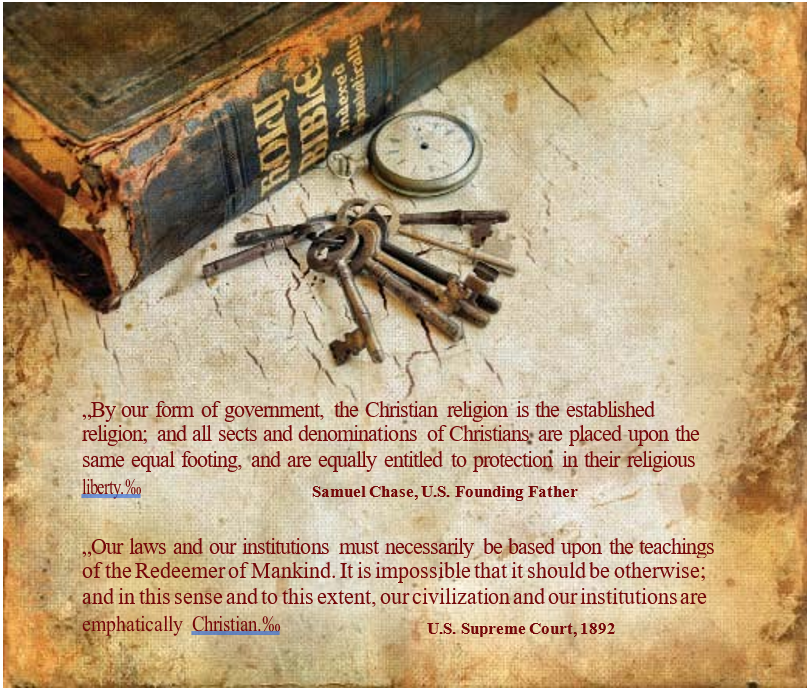
| 5. “By our form of government, the Christian religion it is the established religion.” | E. Robert E. Lee |
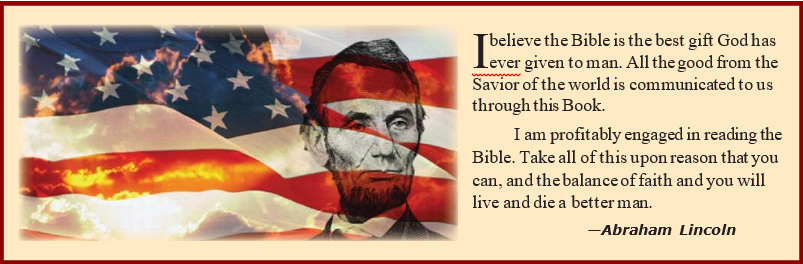
| 6. “I believe the Bible is the best gift God has ever given to man.” | F. Vance Havner |
| 7. The Bible “has never failed to give me light and strength.” | G. Theodore Roosevelt |
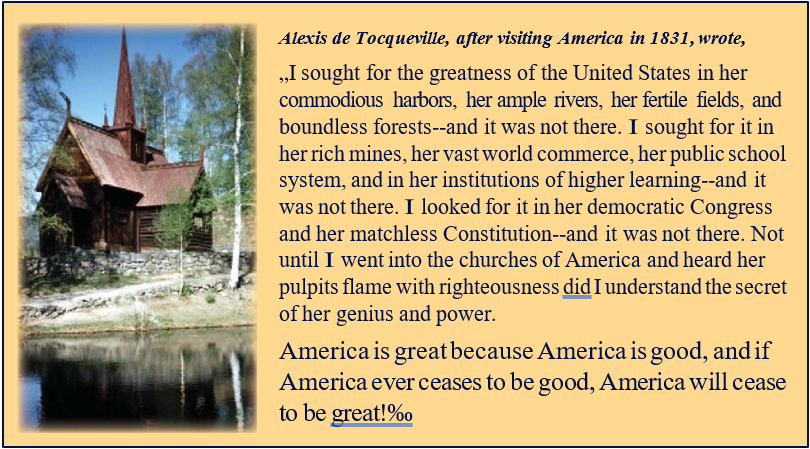
| 8. “America is great because America is good.” | H. George Washington |
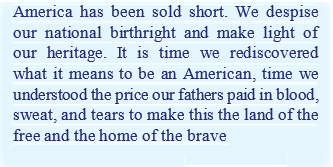
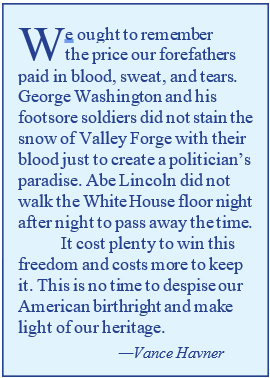
| 9. “This is no time to despise our American birthright & make light of our heritage.” | I. Christopher Columbus |
| 10. “We plead for a closer, wider and deeper study of the Bible.” | J. John Adams |
| 11. The word of God should lay at the foundation of all of our schooling… | K. Abraham Lincoln |
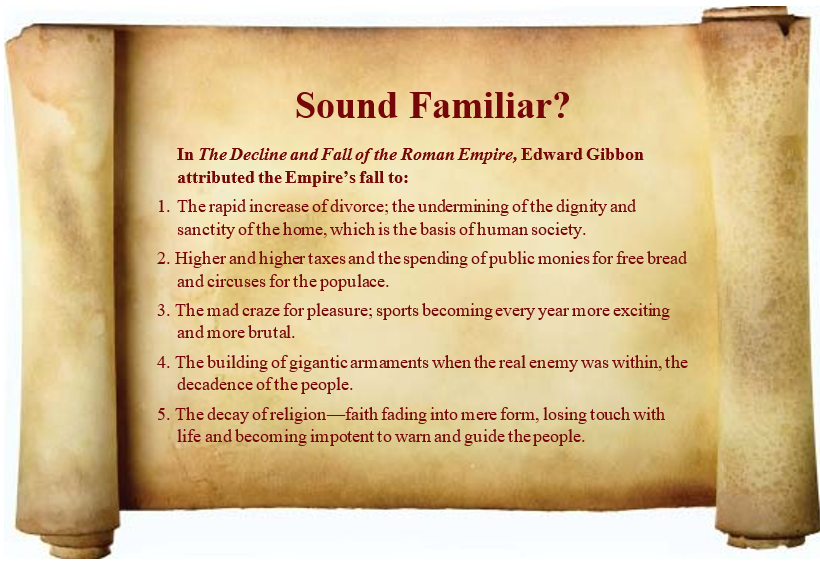
| 12. “Faith fading into mere form” helps lead to a fall. | L. Edward Gibbon |